PSS 212
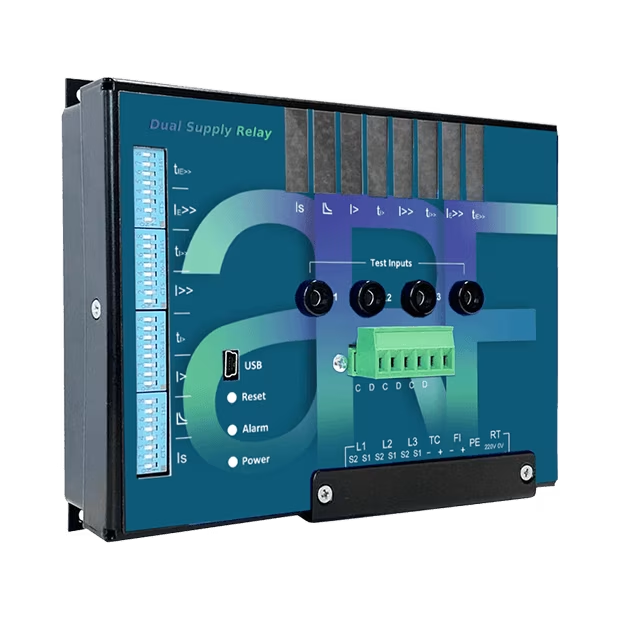
Self-Powered Feeder Protection Relay
The self supply PSS 212 provides definite-time and inverse-time 3 phase overcurrent protection and earth fault current protection for electrical power systems.Key Features
Self-Powered or Dual-Powered Versions
The EKOSsr 50 can be ordered in either self-powered or dual-powered configurations.
Manual Configuration
It can be fully configured manually, eliminating the need for setting software.
Customization via USB
The EKOSsr 50 setting software allows customization of configuration parameters via a USB port.
Additional Functions
The relay offers measurement, monitoring, and recording functions accessible via the communication port.
Capacitance Discharge Output
Capable of providing sufficient power to a low-energy trip coil of a circuit breaker.
Flag Indicator
An external flag indicator indicates whether a trip event has occurred.
Rear RS485 Port
Allows control of the circuit breaker (with close and trip commands).
Flexible Mounting Options
Housed in an optional flush or wall-mounting metal case, it can be easily adapted to various applications.
Technical Data
Nominal Frequency
50/60 Hz
Phase Current Measurement
5% pickup accuracy (rms of the three-phase input currents)
Phase Current Setpoint Limits:
- I > 0.9 to 2.5 x IS
- I >> 1 to 20 x IS
Neutral Current Measurement
Computed from the three-phase input currents (IE >> 0.2 to 2.5 x IS)
Neutral Current Tripping Time
tIE >> 0.1s to 20s
Definite-Time Overcurrent Element Tripping Time Setting Limits
tI > 0.04 to 300s
Inverse-Time Overcurrent Characteristics
- Normal Inverse (N-INV)
- Very Inverse (V-INV)
- Extremely Inverse (E-INV)
- Long Time Inverse (L-INV)
- RI-Inverse (RI-INV)
Fuse Characteristics:
- HV Fuse
- Full Range Fuse (FR-Fuse)
Time Factor:
0.05 to 10
Tripping Times for Definite-Time Short Circuit Element
tI >> 0.04s to 3s
Technical Questions
Self-supply relays are grid protection elements, especially used in remote power plants where access is limited or expensive. Self-supply relays derive their own power from the line it protects, eliminating problems arising from batteries and rectifiers on site.
In industrial automation and control systems, relays act as electrically operated switches. They are used to control high-power devices or multiple devices with lower power control signals. Relays help automate processes by allowing a small control signal to manage larger electrical loads, enabling the seamless integration of various components in industrial systems.
When selecting a MV relay for a specific application, the load requirements need to be considered to ensure the relay can handle the voltage and current appropriately. Verification of compatibility between the coil voltage and the control system is necessary for effective activation of the relay.
Other Products

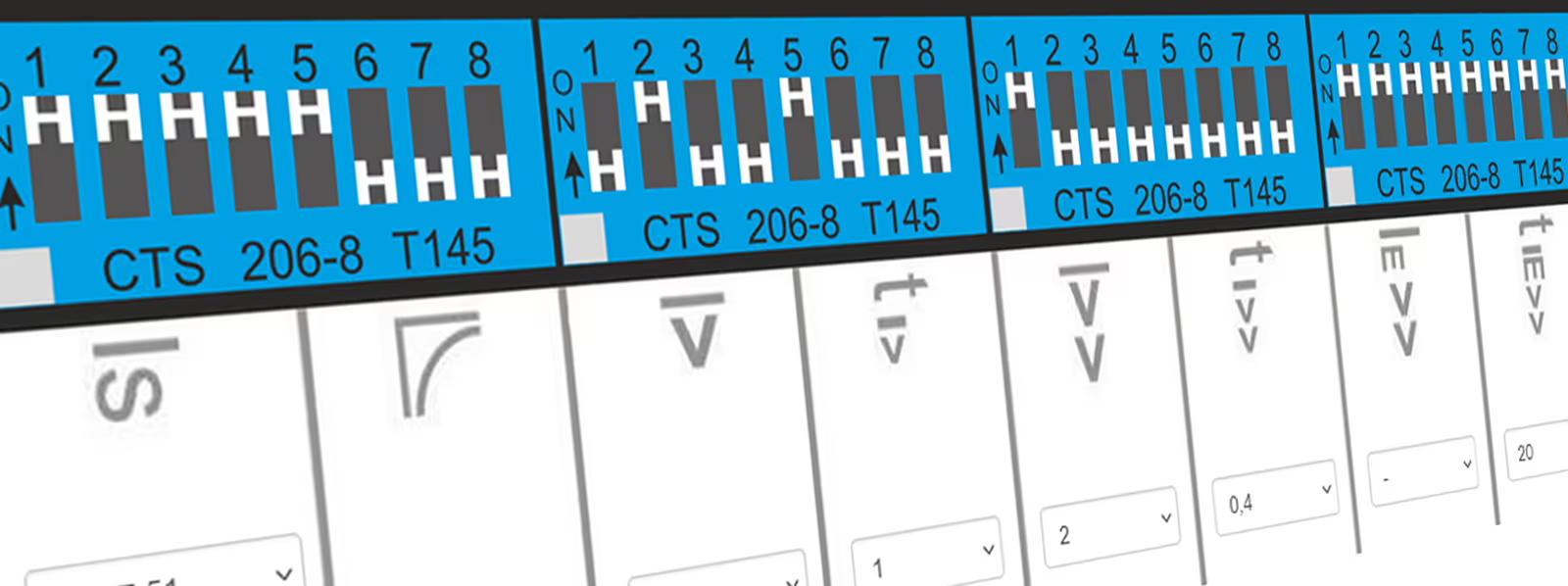

Try PSS 212
Dip Switch Test
The PSS 212 which meets the highest requirements on a digital protection device, is a CT-powered protection relay occupies minimum space. Simple and safe wiring, high electromagnetic interference immunity, easy adjustment and the ability to scale to different power quantities of the switchboard are important advantages.